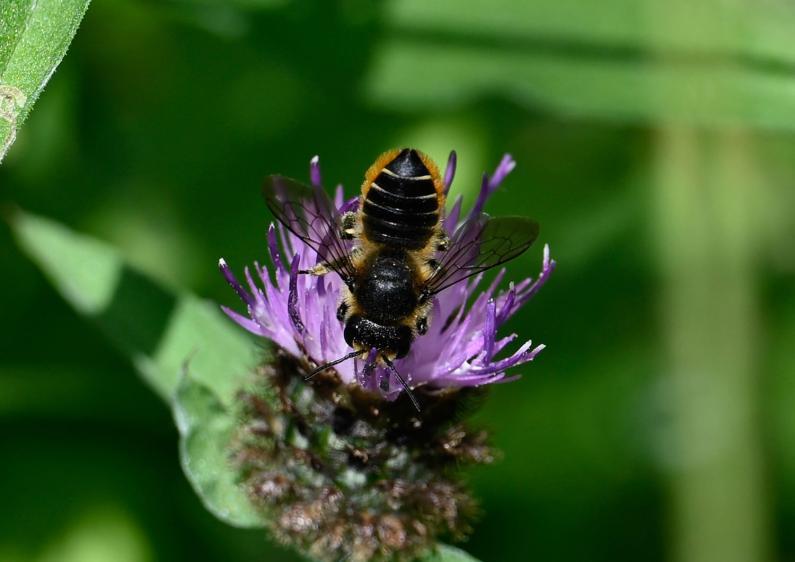
Patchwork Leafcutter Bee

Patchwork Leafcutter Bee, female, Heene Cemetery, early July 2025.

Species introduction

At a glance
Latin name: 
Megachile centuncularis
Family: 
Mason bees
Family Latin name: 
MEGACHILIDAE
Category: 
Insects other

Species description

Species description

This is a relatively small leafcutter bee (with a forewing span of 7–8.5mm for females), the first Sussex recording of which was in Bognor Regis in 1891. It's widely distributed within the county and can be found almost anywhere, although gardens are its most likely haunt.

It's a distinctive bee. Females especially have a dramatic reddish-orange pollen brush. These are hairs on the underside of the abdomen that collect pollen when the insect brushes itself against flowers. When viewed from above — as clearly seen in the photograph on this page — these hairs form a distinctive halo around the brown of the abdomen, easily visible in the field.

They appear between May and September. The individual shown here was photographed on Common Knapweed in early July, where it would have been seeking both nectar and pollen. This species also favours daisies and plants in the pea family for the nutritional resources they offer. Note the distinctive 'handstand' posture adopted by this bee as it forages. It also curls its abdomen upwards to aid better pollen collection on its abdominal brushes. This is characteristic of all leafcutter bees.

This leafcutter builds nests in pre-existing cavities (in dead trees, bug hotels, plant stems and walls). Every brood cell is lined with a slice of leaf that it cuts from various plants; roses are a special favourite — you may have seen the tell-tale circular holes in rose leaves. It will also take leaf sections from Lilac, Birch, Horse Chestnut, Ash, Amelanchier, willowherbs and honeysuckle. Leaf material is used to seal the entrance. Female Patchwork Leafcutter Bees may construct as many as 30 brood cells in a year.

Seven different types of leafcutter bee (Megachile) have been seen in Sussex.

Species photographs

Larger photograph(s) (click to magnify)

Details

Species family information

Mason bees (also known as leafcutter bees) are mostly solitary bees. Several collect plant or animal hairs to assist in nest construction, whereas other collect plant resin for this purpose. All feed on pollen and nectar, although some of these feed on pollen collected by other bees (and so are called 'cuckoo bees').

Category information

Insects evolved in the Ordovician from a crustacean ancestral lineage as terrestrial invertebrates with six legs (the Hexapoda). This was the time when terrestrial plants first appeared. In the Devonian some insects developed wings and flight, the first animals to do so. An early flying group was the Odonata from the Carboniferous, the damselflies and dragonflies, which have densely-veined wings and long, ten-segmented bodies. They are day-flying carnivores, with an aquatic larval stage, so are commonly seen flying near water. The carnivorous larvae are called nymphs. Odonata species are short-lived, damselflies surviving for 2-4 weeks, dragonflies for up to 2 months.

Some insect groups in the Cretaceous co-evolved with the flowering plants, and they have had a close association ever since. These groups are the Hymenoptera (bees, wasps, and ants), the Lepidoptera (butterflies and moths), the Diptera (flies), and the Coleoptera (beetles). The diversity of beetles is astonishing. Of all the known animal species on the planet, one in five is a beetle!