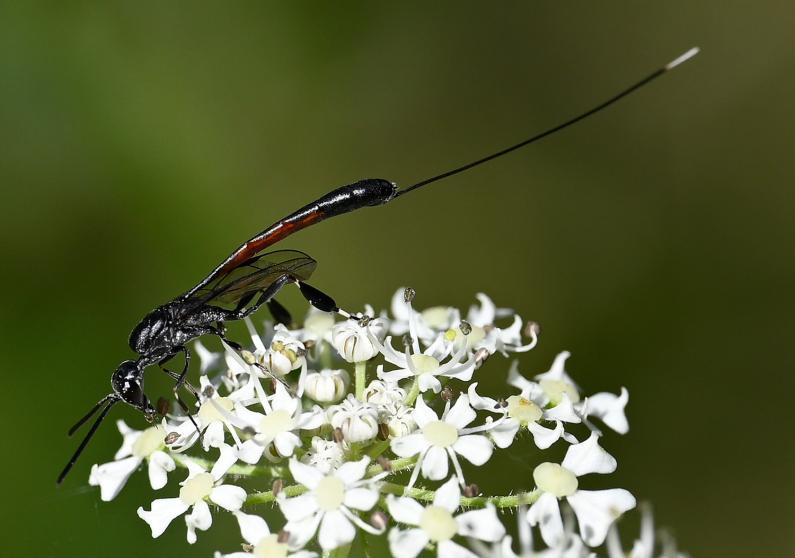
Gasteruption or pennant wasp - unnamed 1

Female Gasteruption jaculator, a parasitic wasp, Heene Cemetery, mid-July 2025.

Species introduction

At a glance
Latin name: 
Gasteruption jaculator
Family: 
Gasteruption or pennant wasps
Family Latin name: 
Gasteruptiidae
Category: 
Insects other
Vernacular names: 

Greater Pennant Wasp

Species description

Species description

Gasteruption wasps are often on the must-see lists of many entomologists, amateur or professional, because they seem to depart so radically from what one thinks of as being 'a wasp'. They have unusually elongated 'necks', their hind tibias (the fourth section of the leg) are swollen, and the well-known 'wasp waist' is attached to the propodeum (main part of the body) so much higher than is the case with other wasps. This gives them an absolutely alien appearance, as they move about, appearing to be half praying mantis, half childhood game metal jack.

Several of these were seen in the Cemetery in mid-July 2025. All were taking nectar from Hogweeds, an umbellifer of great value to a range of insects. Females of Gasteruption jaculator are shown here (as close as one can say without microscopic examination). This name is a lovely composite from the Latin jaculari, to hurl, and the Greek gaster, meaning stomach, and eruption. Now that science has since uncovered the function of the female's ovipositor as an egg-laying organ, not a stinger, we can appreciate that the name is misplaced—albeit intriguing!

Females of this species have distinct markings: dark-orange abdominal bands, white bands on the hind first tarsus, and white smudges at the top of the hind femur and fore tibia. Otherwise, black mostly prevails.

Gasteruption wasps—of which there are five species in Britain—are parasitic wasps. The extraordinarily long ovipositors (hypodermic-like egg-laying organs) are used by females to insert eggs into the sealed nest cells of solitary bees or wasps. (ovipositors (hypodermic-like egg-laying organs) which are used by females to insert eggs into the sealed nest cells of solitary bees or wasps. Records suggest that they parasitise Plasterer (Hylaeus) Bees.) When the parasitic eggs hatch, they start feeding on the grubs that they find alongside. They will then devour the food larder that the host parent had placed there for their own grubs.

Species photographs

Larger photograph(s) (click to magnify)

Details

Species family information

Gasteruptiidae wasps are a relatively advanced family of apocritan wasps (ones with the characteristic 'wasp waist'). It consists of perhaps 500 species worldwide. Their physical characteristics, described above, are both fascinating and unusual. Females generally have extremely long ovipositors, used to deposit eggs into the nest cells of solitary bees and wasps.

Category information

Insects evolved in the Ordovician from a crustacean ancestral lineage as terrestrial invertebrates with six legs (the Hexapoda). This was the time when terrestrial plants first appeared. In the Devonian some insects developed wings and flight, the first animals to do so. An early flying group was the Odonata from the Carboniferous, the damselflies and dragonflies, which have densely-veined wings and long, ten-segmented bodies. They are day-flying carnivores, with an aquatic larval stage, so are commonly seen flying near water. The carnivorous larvae are called nymphs. Odonata species are short-lived, damselflies surviving for 2-4 weeks, dragonflies for up to 2 months.

Some insect groups in the Cretaceous co-evolved with the flowering plants, and they have had a close association ever since. These groups are the Hymenoptera (bees, wasps, and ants), the Lepidoptera (butterflies and moths), the Diptera (flies), and the Coleoptera (beetles). The diversity of beetles is astonishing. Of all the known animal species on the planet, one in five is a beetle!