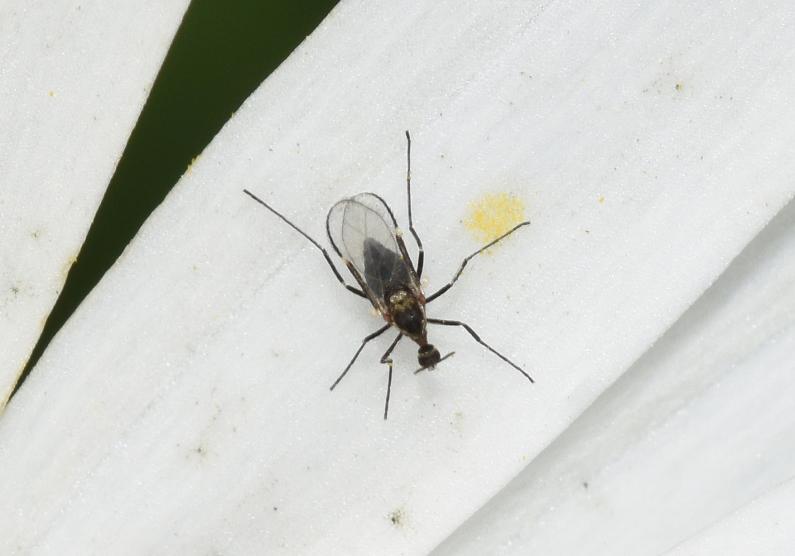
Gall midge - unnamed 1

These tiny, fragile insects (no longer than 2 or 3 millimetres) feed within plant tissue.

Species introduction

At a glance
Latin name: 
Cecidomyiidae sp.
Family: 
Gall midges
Family Latin name: 
Cecidomyiidae
Category: 
Insects other
Vernacular names: 

Gall gnats

Species description

Species description

These tiny, fragile insects (no longer than 2 or 3 millimetres) feed within plant tissue. They have unusually hairy wings (infrequent for flies) and long antennae (not visible in the photograph shown here, which was taken from above).

Although there are perhaps 650 species of Gall midges in Britain, there may be ten times that number worldwide.

Because of their size and behaviour, one rarely sees these creatures. Their presence, however, will be evident in the form of the leaf galls that result from their activity. They typically oviposit their eggs into the surface tissue of plants. These develop into mutations, galls, bumps and lumps as the larvae inside mature.

Species photographs

Larger photograph(s) (click to magnify)

Details

Species family information

Although Gall midges do cause crop damage, some members of this family are beneficial as their larvae are predatory. As is also the case with some hoverflies, as their larvae emerge, they feed on aphids; Gall midge larvae also feed on spider mites and scale insects. As a result of this relationship, it has often been noted that outbreaks of aphids on crops will be followed by substantial populations of adult Cecidomyiidae laying their eggs.

Category information

Insects evolved in the Ordovician from a crustacean ancestral lineage as terrestrial invertebrates with six legs (the Hexapoda). This was the time when terrestrial plants first appeared. In the Devonian some insects developed wings and flight, the first animals to do so. An early flying group was the Odonata from the Carboniferous, the damselflies and dragonflies, which have densely-veined wings and long, ten-segmented bodies. They are day-flying carnivores, with an aquatic larval stage, so are commonly seen flying near water. The carnivorous larvae are called nymphs. Odonata species are short-lived, damselflies surviving for 2-4 weeks, dragonflies for up to 2 months.

Some insect groups in the Cretaceous co-evolved with the flowering plants, and they have had a close association ever since. These groups are the Hymenoptera (bees, wasps, and ants), the Lepidoptera (butterflies and moths), the Diptera (flies), and the Coleoptera (beetles). The diversity of beetles is astonishing. Of all the known animal species on the planet, one in five is a beetle!