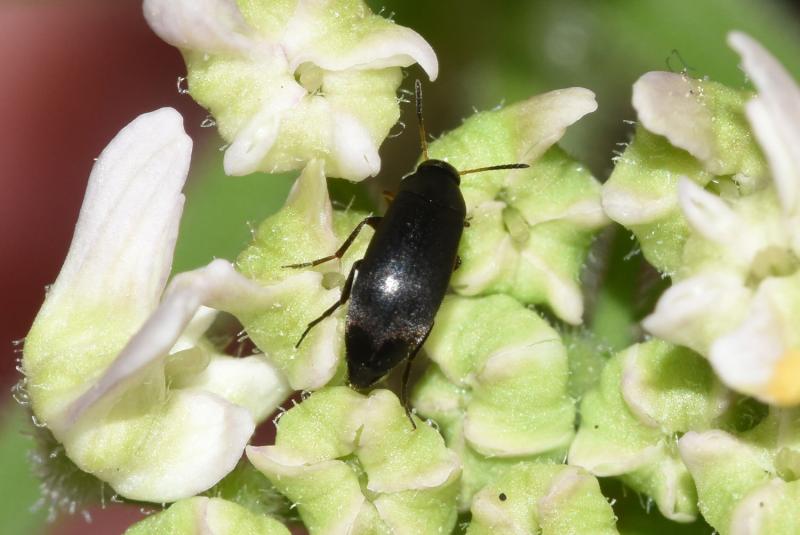
False Flower Beetle - unnamed 2

This small black beetle is often associated with Hawthorn and umbellifers (as here).

Species introduction

At a glance
Latin name: 
Anaspis frontalis
Family: 
False flower beetles
Family Latin name: 
Scraptiidae
Category: 
Insects other

Species description

Species description

This False flower beetle is the most common of its genus. It is sometimes associated with Hawthorn blossom but is also found on umbellifer flowers (as seen here in mid-July). This species is between 2.5 and 4.5 mm in length. They are usually entirely black, although legs and antennae can be yellow or shading away from black.

These are widespread beetles, seen in spring and summer. They are saproxylic insects, developing in the decaying wood of deciduous trees.

For the curious, the genome sequence of this species can be read about on the Wellcome Open Research website. An interactive version of the BlobToolKit snail plot provides an interesting overview.

Species photographs

Larger photograph(s) (click to magnify)

Details

Species family information

False flower beetles are represented by around 400 species of beetle worldwide. They are found on flowers, sometimes in large numbers.

Category information

Insects evolved in the Ordovician from a crustacean ancestral lineage as terrestrial invertebrates with six legs (the Hexapoda). This was the time when terrestrial plants first appeared. In the Devonian some insects developed wings and flight, the first animals to do so. An early flying group was the Odonata from the Carboniferous, the damselflies and dragonflies, which have densely-veined wings and long, ten-segmented bodies. They are day-flying carnivores, with an aquatic larval stage, so are commonly seen flying near water. The carnivorous larvae are called nymphs. Odonata species are short-lived, damselflies surviving for 2-4 weeks, dragonflies for up to 2 months.

Some insect groups in the Cretaceous co-evolved with the flowering plants, and they have had a close association ever since. These groups are the Hymenoptera (bees, wasps, and ants), the Lepidoptera (butterflies and moths), the Diptera (flies), and the Coleoptera (beetles). The diversity of beetles is astonishing. Of all the known animal species on the planet, one in five is a beetle!