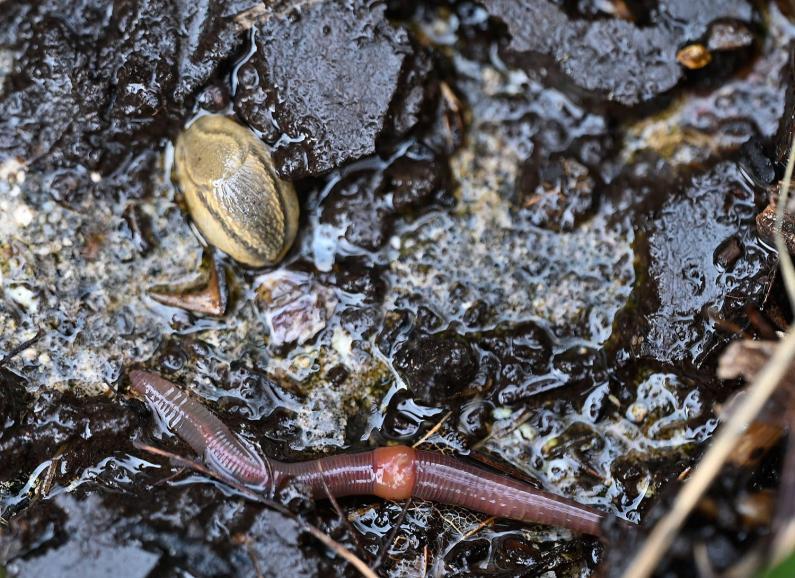
Bourguignat's Slug

Bourguignat's Slug has a grey to yellow-brown back with dark lateral banding.

Species introduction

At a glance
Latin name: 
Arion fasciatus
Family: 
Slugs
Family Latin name: 
Arionidae
Category: 
Invertebrates
Vernacular names: 

Rusty False-keeled Slug, Orange-banded Arion

Species description

Species description

Bourguignat's Slug has a grey to yellow-brown back with dark lateral banding. A yellowish flush is often visible between the lateral stripe and the near-white sole. There is usually what is called a 'false keel', along the ridge of the back.

It is usually found all year round in waste ground and gardens. It is widespread and relatively common.

Species photographs

Larger photograph(s) (click to magnify)

Details

Species family information

Slugs are unshelled gastropod molluscs, and have the same food preferences as snails, mainly herbivorous, but also omnivorous and carnivorous. The herbivorous and omnivorous slugs eat rather more dead that living material compared to snails, and as such are useful scavengers and recyclers in the garden. They have a horny plate concealed under the mantle, or saddle, but no shell, so maintaining body moisture is essential, which is why they are so active after rain, and during the night when it is cool. 

Like snails they propel themselves with a muscular 'foot'. Slugs leave their scent in their slime trails, which assists in navigation and own species recognition. Slugs have teeth, and so can bite, and carnivorous slugs may hunt by following slime trails. All slugs are hermaphrodites, so when they mate both individuals produce eggs. Strongly smelling native plants with hairy stems help control slugs, such as lavender, rosemary and cranesbills, but better is to encourage hedgehogs, rodents, ground beetles, glow-worms (which feed exclusively on slugs and snails), and birds. 

Do not use chemicals, especially if you have pets. The most helpful feature of these Roundback Slug family members is that these slugs do not have a keel on the back, unlike the keelback slugs.

Category information

Centipedes, millipedes, and their kin are collectively called myriapods. Centipedes are carnivores, and have one pair of jointed legs per body segment, which never have 100 segments, but vary from 30 to 354. Millipedes have two pairs of jointed legs per body segment, up to 333 in number, and mostly feed on decaying plant material. Myriapods are arthropods and share a common ancestor with the crustacea, that includes insects, which in turn share a common ancestor with the arachnids. Arthropods have an exoskeleton, a segmented body, and paired, jointed appendages. They have highly developed sense organs. 84% of all species on the Earth are arthropods. Crustacea generally have two pairs of appendages (antennules and antennae) in front of the mouth and paired appendages near the mouth that function as jaws. They occupy a wide range of habitats, and many are aquatic, although the largest group in terms of number of species, the insects, are mainly terrestrial. Woodlice are common crustaceans in gardens.

Earthworms are annelids, evolving on a separate lineage to the arthropods, but they share a common ancestor with the molluscs. The Annelida is a large group of segmented worms, also called ring worms. Molluscs are a large, diverse group of invertebrates, which have unsegmented bodies enclosed within calcareous shells, and are represented in gardens mainly by terrestrial gastropods such as snails and slugs. Other molluscs, particularly the bivalves and cephalopods, are aquatic. Representatives of all these groups are found in the cemetery.